
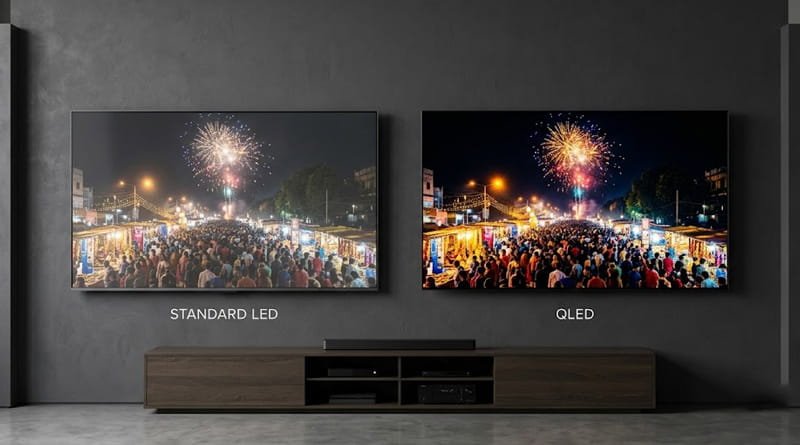
With the Amazon Great Indian Festival sales approaching, upgrading your home entertainment system has never been more tempting. As you browse through endless pages of massive discounts on 4K televisions, you will inevitably hit the biggest dilemma for modern buyers: choosing between a qled vs led smart tv.
While standard LED televisions have dominated the budget and mid-range markets for years, QLED (Quantum Dot LED) technology has rapidly dropped in price, making it accessible to everyday Indian households. But is the visual upgrade actually noticeable to the average viewer? Understanding the physical hardware differences in a qled vs led smart tv comparison is the only way to determine if spending the extra ₹3,000 to ₹8,000 during festive sales is a smart investment or an unnecessary luxury.
★ QUICK RECOMMENDATION: AT A GLANCE TOP QLED PICK
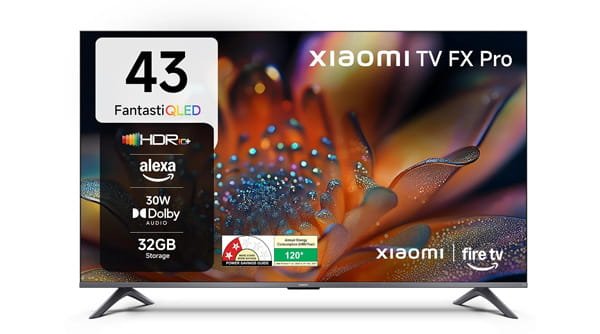
🏆 #1 Best Value QLED TV for Indian Living Rooms: Xiaomi 43-Inch A Pro QLED Smart TV
Features a stunning Quantum Dot display for 100% color volume, Google TV OS, Dolby Audio, and a premium bezel-less metallic frame—currently sitting at its lowest festival price!
What is the Real Difference Between QLED vs LED Smart TV Panels?
To make an informed decision, you must look behind the glass screen. Both LED and QLED televisions share the same foundational technology: they both use an LCD (Liquid Crystal Display) panel illuminated by a backlight. However, the difference lies in a microscopic filter.
Standard LED Displays
A traditional LED TV uses white light-emitting diodes (LEDs) to shine light through an LCD matrix and color filters (Red, Green, and Blue) to create the picture you see. While this technology is highly reliable and cheap to manufacture, the “white” backlight is rarely pure white—it often leans slightly blue or yellow. This limits how accurately the TV can produce deep, vibrant colors.
QLED (Quantum Dot LED) Displays
A QLED TV fundamentally changes the backlight system. Instead of using white LEDs, it uses pure blue LEDs. The light passes through a special film packed with microscopic nanocrystals called “Quantum Dots.” When the blue light hits these dots, they glow with perfect, mathematically precise red and green light.
This pure combination of Red, Green, and Blue allows the QLED panel to display over a billion highly accurate colors. In any qled vs led smart tv side-by-side test, the QLED will look noticeably more vibrant and saturated.
To understand how screen sizes and resolutions tie into these panel types, read our comprehensive Complete Smart TV Buying Guide India before finalizing your purchase.
Brightness and Glare: Winning in Indian Living Rooms
One of the most critical factors in the qled vs led smart tv debate is peak brightness (measured in nits). Most Indian living rooms feature large windows or balconies that let in heavy natural sunlight during the day.
- LED TV Brightness: Standard budget LED TVs typically peak at around 250 to 350 nits of brightness. If you place an LED TV opposite a bright window, the sunlight will wash out the picture, causing severe reflections that make dark movie scenes impossible to see.
- QLED TV Brightness: Because Quantum Dots are highly efficient at transmitting light, QLED panels easily push peak brightness levels from 400 nits to over 1,000 nits. If your TV room is flooded with daylight or bright tubelights, a QLED TV will slice through the glare, maintaining a crisp, highly visible picture.
Color Accuracy: Does Quantum Dot Matter for OTT Streaming?
When you subscribe to premium plans on Netflix, Disney+ Hotstar, or Amazon Prime Video, you are paying for 4K Ultra HD content mastered in HDR10+ and Dolby Vision.
Standard LED TVs simply cannot display the full color spectrum required by Dolby Vision. When watching visually intense movies or nature documentaries, a standard LED might make a deep crimson red look slightly orange or washed out.
Conversely, a QLED TV achieves “100% Color Volume.” This means that even when the screen gets intensely bright (like an explosion in an action movie), the colors do not lose their saturation. If you are a heavy consumer of 4K OTT content, the winner of the qled vs led smart tv battle is strictly QLED.
⚡ BEST DIRECT LED CHOICE FOR BUDGET BUYERS
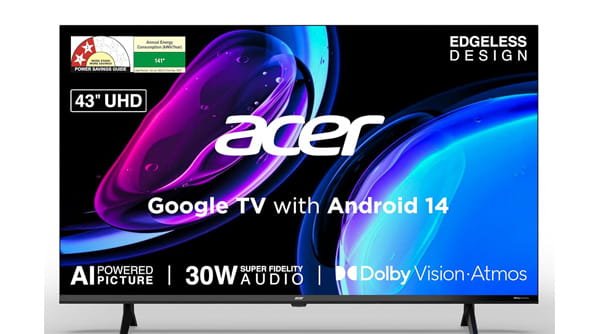
⚡ Best Pick for Bedrooms & Budget Buyers: Acer 43-Inch Advanced I Series 4K TV
If you want standard LED reliability with massive 30W Dolby Atmos speakers and a lag-free Google TV interface under ₹22,000, this is the ultimate festival steal.
Price vs. Value: Is the Upgrade Worth It During Festival Sales?
Historically, QLED TVs cost nearly double the price of their LED counterparts. However, going into the 2026 Amazon Great Indian Festival, the price gap has shrunk dramatically.
- A reliable 43-inch 4K LED TV currently costs between ₹20,000 and ₹23,000.
- A modern 43-inch 4K QLED TV currently costs between ₹24,000 and ₹27,000.
For a price difference of just ₹3,000 to ₹4,000, upgrading to a QLED panel is an absolute no-brainer. You are getting vastly superior color depth, better daylight visibility, and future-proofing your living room for the next 7 to 10 years.
If you are strictly shopping for a secondary TV for a small bedroom or guest room where cinematic color isn’t a priority, a budget LED is still a fantastic choice. You can explore our top budget picks in our 5 Best 32 Inch Smart TVs Under 15000 in India guide.
Burn-In Risk and Lifespan Durability
When researching advanced TV panels, many buyers confuse QLED with OLED (Organic LED). OLED TVs have a known risk of “burn-in,” where static images (like news channel logos or cricket scoreboards) get permanently ghosted into the screen over time.
In the qled vs led smart tv comparison, you do not have to worry about burn-in at all. Because both QLED and standard LED TVs use inorganic LCD backlights, they are immune to screen burn-in. You can comfortably pause a video game or leave a news channel running for hours without damaging the Quantum Dot layer.
If you are setting up a comprehensive living room, consider coordinating your TV purchase with other household upgrades by checking our 5 Best Air Fryers Under 4000 for Home Use in India to complete your modern home.
Final Verdict: Which TV Should You Buy in 2026?
Solving the qled vs led smart tv puzzle ultimately comes down to where you are placing the television and your entertainment habits.
Buy a QLED Smart TV if:
- You are placing the TV in a primary living room with large windows and heavy sunlight.
- You watch high-quality 4K HDR movies on Netflix, Apple TV, or Amazon Prime.
- You want the most vibrant, saturated colors available without paying the massive premium for an OLED display.
Buy a Standard LED Smart TV if:
- You are buying a secondary TV for a dark bedroom, hostel, or guest room.
- You primarily watch standard 1080p cable TV set-top box channels or daily news.
- You are on a strict, unbendable budget and prefer to spend the extra money on an external soundbar.
With massive festival discounts currently live, now is the absolute best time to secure a premium QLED television at standard LED prices.
🎯 FINAL VERDICT: READY TO BUY ON AMAZON INDIA?